
Foundations
It starts in the soil
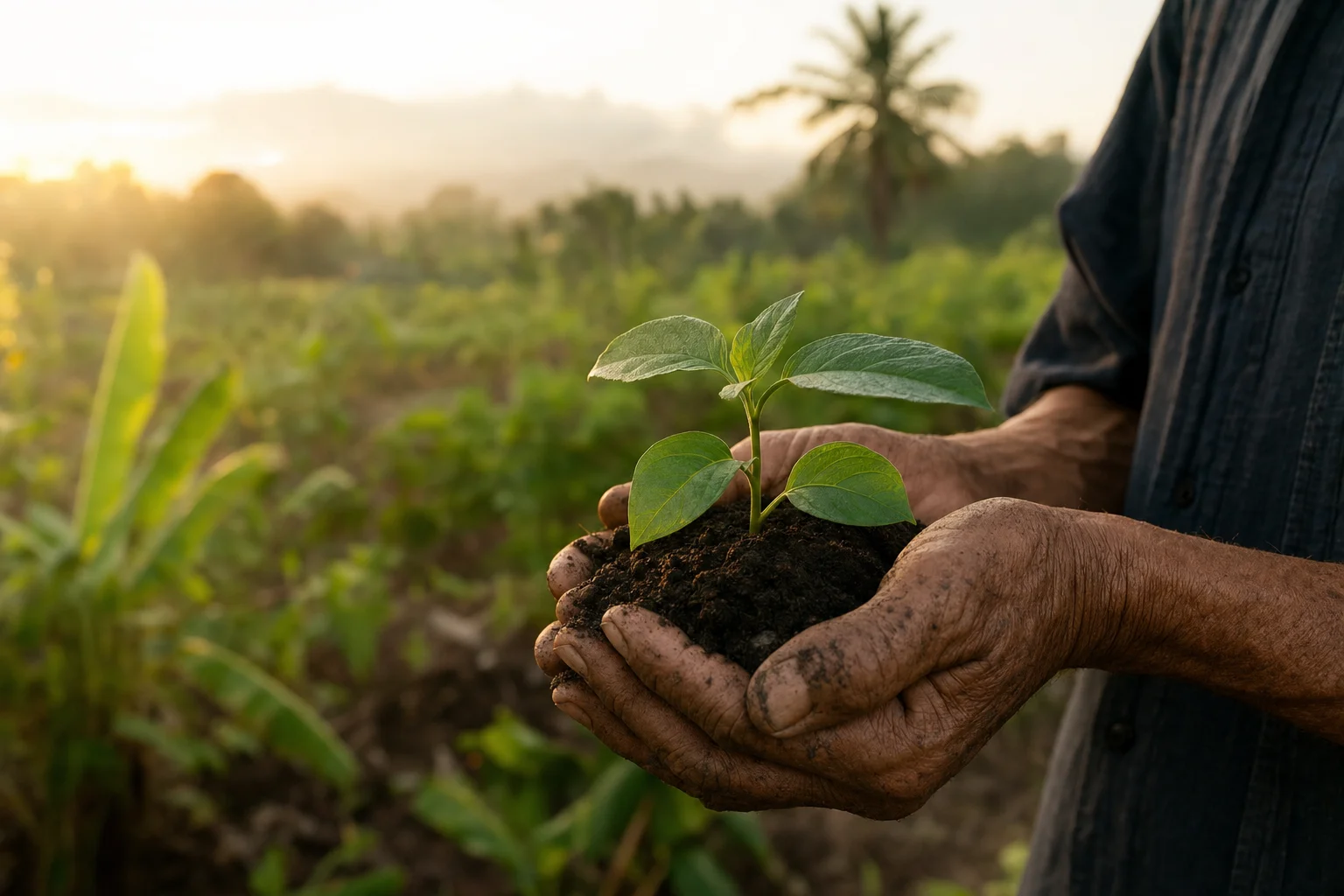
Every food system stands on a few centimetres of living topsoil. Conventional agriculture treats soil as a substrate to be dosed; organic agriculture treats it as the crop before the crop. Compost and green manures return organic matter, rotation breaks pest cycles and rests the ground, and the absence of synthetic fertiliser leaves the microbial life of the soil intact.
The results are measurable. Organically managed soils hold around 26 percent more carbon, drawing it out of the atmosphere and storing it as fertility. They also hold more water, which cuts irrigation needs by as much as a fifth and makes fields more resilient in drought and cyclone seasons alike. Healthy soil is climate policy you can stand on.
Water
What never reaches the lagoon
Agriculture uses about 70 percent of the world’s freshwater and is a leading source of water pollution. On a small island the chain is short and unforgiving: what is sprayed on a field travels down rivers to the coast, and Mauritius lives from its coast. Nutrient runoff from synthetic fertilisers feeds the algal blooms that smother reefs; pesticide residues do the rest.
Organic farming removes that chemistry at the source. No synthetic fertiliser means no nitrate plume in the groundwater; no synthetic pesticides means nothing to carry to the reef. Choosing organic is not only a decision about your kitchen. On an island, it is a decision about the sea.
30%
More species
of plants, insects and birds on organic farms
50%
More pollinators
pollinator species thrive where neonicotinoids are banned
26%
More soil carbon
stored in organically managed soils
45%
Less energy
used by organic systems per unit of land
Wildlife
Farms that hum
Walk an organic farm and you hear the difference before you see it. Research consistently finds around 30 percent more species of plants, insects and birds on organic land, and around half again as many pollinator species. Hedgerows, wildflower strips and unpoisoned margins turn a field into a habitat.
Pollinators are the quiet infrastructure of food. The neonicotinoid insecticides implicated in bee decline are banned in organic farming, full stop. For Mauritius, whose endemic flora depends on a small and fragile web of pollinators, every uncontaminated hectare counts.
Climate
The greenhouse gas ledger
The food system produces roughly a quarter of global greenhouse gas emissions. Organic farming attacks the worst line items: it uses around 45 percent less energy per unit of land, it stores more carbon in soil, and by refusing synthetic nitrogen fertiliser it avoids much of the nitrous oxide, a gas around 300 times more potent than CO2, that conventional fields emit.
We will be honest about the counterargument too: organic yields are lower, so per kilogram of some foods the picture is closer than per hectare. The strongest climate lever remains what you eat and how it was produced, which leads to the question every thoughtful customer in Mauritius eventually asks us.
The honest bit
But you import everything. What about the miles?
Fair question, and we answer it with data rather than defensiveness. Weber and Matthews (2008) found that transport accounts for around 11 percent of food-related emissions, while production accounts for around 83 percent. The type of food and the way it was grown dwarf the distance it travelled. Clark and Tilman’s 2017 analysis in Nature reached the same conclusion: food type matters far more than food miles.
Our part of the bargain is to move food the lightest way possible. Almost all of our volume crosses the ocean by container ship, which carries far less impact per kilogram than flying it, and we reserve air freight for the few perishables that cannot survive 28 days at sea. The trade-offs we are not proud of are set out on our transparency page, and our plans to shrink them are on the sustainability page.
Questions
Frequently asked questions
- Is organic farming really better for biodiversity?
- Yes, and the effect is one of the most consistent in agricultural research. Organic farms host around 30 percent more species of plants, insects and birds than conventional farms, and around 50 percent more pollinator species. Bee-harming neonicotinoid pesticides are banned in organic production.
- Does importing organic food to Mauritius cancel out its environmental benefit?
- The evidence says no. Weber and Matthews (2008) showed transport is only around 11 percent of food-related greenhouse gas emissions, while production is around 83 percent. Nearly all our volume travels by container ship, which carries a small fraction of the impact of air freight per kilogram. What is grown, and how, matters far more than how far it moved.
- What does organic farming do for the sea?
- It stops the problem at the source. Organic farms use no synthetic fertilisers or pesticides, so there is no synthetic runoff to feed algal blooms or poison reef life downstream. For an island whose lagoons and corals are its identity and its economy, farming chemistry is a marine issue.
- Is organic farming better for the climate?
- Per unit of land, organic systems use around 45 percent less energy and hold around 26 percent more carbon in their soils, and avoiding synthetic nitrogen fertiliser cuts nitrous oxide, a greenhouse gas roughly 300 times more potent than CO2. Yields are lower, so honest comparisons are nuanced, but for the inputs it refuses alone, organic is the lighter system.